

Forgot to thaw dinner?
Salmon fillets or chicken breasts still frozen at 5 p.m.? Set them on the titanium. The manufacturer says they'll thaw faster than on a regular plate.

The double-sided cutting board
Raw meat on one side, fresh produce on the other, and the two never meet. Textured titanium handles chicken, steak and fish. Wheat straw takes care of veggies and fruit. A knife sharpener and a garlic grater are built right in.
KensaiChef is a reversible cutting board with two very different jobs. The top is a titanium plate covered in a laser-etched hexagon pattern the manufacturer calls HexCore. Flip it over and you get a cream-colored surface made from wheat straw fibers. A nonslip rubber rim wraps around both sides, and a cutout handle lets you hang it on a hook.
The concept is dead simple: one side per food group. Raw chicken, ground beef and salmon stay on the titanium. Tomatoes, herbs and fruit go on the wheat straw. That means no more chopping salad right where the steak just was, which helps cut down on cross-contamination in your kitchen.
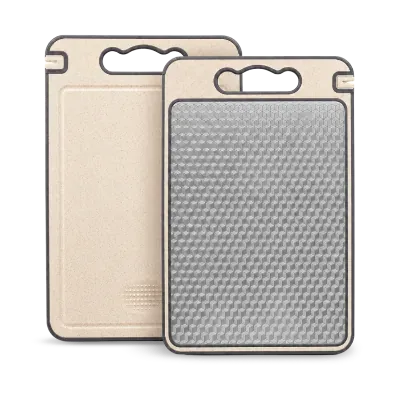
No batteries, no moving parts. It all comes down to materials: how each surface handles a knife edge, meat juices and water.

Metal doesn't soak up blood or juices. Everything stays on the surface and washes right off. The raised hex grid is designed to take knife strikes and keep visible scratches to a minimum. According to the manufacturer, it also helps frozen food thaw faster when you set it on top.
Softer than metal, this plant-fiber surface is where vegetables, fruit and herbs belong. It's built to resist beet and turmeric stains better than bare wood, and one corner has a ridged patch that works as a grater for garlic, ginger or nutmeg.
The rubber edge keeps the board from sliding when you bear down on a roast or a butternut squash. Tucked into one side is a small sharpening slot: a few pulls and your knife is back in business between tasks.
No seasoning, no oiling, no break-in period. Take it out of the box and follow one rule: each side gets its own kind of food.
Chicken breasts, fish fillets, ground beef, shrimp: anything raw gets prepped on the metal side. Need to thaw something? Set it on the same side, still in its packaging.
Flip the board to slice veggies, chop herbs or cut up fruit. Garlic and ginger go straight onto the ridged grater, so you can skip one more gadget.
Wash it under hot water with a little dish soap, or toss it in the dishwasher. Just skip the steel wool. Then hang it by the handle and let it air-dry.
The figures below come from the manufacturer's published product info. Measurements are rounded and may vary slightly from batch to batch.
| Type | Reversible two-sided cutting board |
|---|---|
| Side 1 | Titanium with laser-etched HexCore hexagon texture |
| Side 2 | Wheat straw fiber, cream finish |
| Rim | Charcoal gray nonslip rubber |
| Dimensions | About 12.2 × 8.3 × 0.4 in |
| Weight | About 19.4 oz |
| Built-in tools | Knife sharpener, garlic and spice grater |
| Thawing | Yes, on the titanium side |
| Cleaning | Hand wash or dishwasher-safe |
| Materials (as stated) | BPA-free, non-porous surfaces |
| Storage | Cutout handle for hanging |
| Outdoor use | Grilling, camping, picnics |

It earns its spot on busy nights, when one recipe calls for raw protein and a pile of produce and you don't want to stop and scrub between every step.
Salmon fillets or chicken breasts still frozen at 5 p.m.? Set them on the titanium. The manufacturer says they'll thaw faster than on a regular plate.

Trimming fat off pork chops, filleting fish, slicing steak for fajitas: the juices sit on top of the metal and rinse away under the faucet.

Bell peppers, zucchini, onions and cilantro all go on the cream side, safely away from whatever raw meat was there a few minutes ago.

Rub a garlic clove, a knob of ginger or some citrus zest across the ridged patch. No garlic press to take apart and scrub afterward.
Every board material has a weak spot. The photos below show the usual suspects, and the table shows where KensaiChef lands.


| Feature | KensaiChef | Wood or bamboo | Plastic | Glass or stone |
|---|---|---|---|---|
| Easy on knife edges | Yes | Good | Good | Dulls blades |
| Odors and stains | Mostly resisted | Soaks them up | Depends on wear | Mostly resisted |
| Scratches and grooves | Minimal | Deep | Fast | Rare |
| Raw and fresh kept apart | Two dedicated sides | Needs two boards | Needs two boards | Needs two boards |
| Dishwasher-safe | Yes | Not recommended | Yes | Yes |
| Built-in tools | Sharpener and grater | None | None | None |
General trends by material, not lab results. A well-oiled wood board that's dried properly is still a perfectly good tool.
Here's the easy rule: if it needs to be cooked before you eat it, it goes on the metal. If you could eat it as is, it goes on the wheat straw. Bread, cheese and deli meats belong on the plant-fiber side too.
Want to make it automatic? Always store the board the same way, titanium facing the wall. Flipping it over becomes your cue that you're switching food groups.

Save it for raw protein, shellfish and thawing. It stands up to deboning and carving, and the non-porous surface won't pick up that fishy smell.
Perfect for fine knife work, salad fixings and anything you'll eat raw. It's also home to the grater, handy for garlic, ginger or lemon zest.
Even a great board has limits. Here's the honest list before you buy, so you know exactly what you're getting.
A mix of real-world feedback from buyers, from the raving fans to the ones with a quibble or two, so you can see how it holds up day to day.
My old bamboo board held on to every smell. Now I mince garlic on the tan side, give it a quick wipe, and the next morning my strawberries taste like strawberries. Didn't expect such a small switch to change my routine this much.Verified purchase
I had a glass board that came free with a knife set and it was chewing up my blades. Since switching to the titanium side, my edges stay sharp way longer. I mostly use the side sharpener on my paring knife, super handy mid-prep.Verified purchase

The two-sided idea is genius. I never have to think twice about chicken versus salad anymore. Knocking off one star for size: for a big head of cabbage or a watermelon, I still pull out my large board. For everything else, it's perfect.Verified purchase
I meal prep the whole week on Sundays: chicken breasts on one side, broccoli and peppers on the other, then the whole thing goes in the dishwasher. One board instead of three, more counter space, and it hangs on the wall when I'm done.Verified purchase
Thanks to the rubber edge it doesn't budge, and the titanium side feels seriously well made. Only gripe: the knife makes a slight metallic sound at first, but you stop noticing after a few days. Took it camping this summer and it was great.Verified purchase
I tossed my old plastic board once I noticed all the blackened scratches. This one stays clean, even after paprika rubs and marinades. Went with the 2-pack so one lives out by the grill and the other never leaves the kitchen.Verified purchase
The manufacturer offers three bundles, and the more you get, the less each board costs: from $59.95 for one down to $44.95 apiece in the 3-pack. Great for a vacation home, a college kid's first apartment or gifting.
1 board

$59.95 each
Total: $59.95, free shipping
List price $83.25-28%
2 boards
$49.95 each
Total: $99.90, free shipping
Was $166.50-40%
3 boards
$44.95 each
Total: $134.85, free shipping
Was $249.75-46%
Cleaning, the dishwasher, shipping times: the questions people usually ask before they pull the trigger.
The titanium side is made for raw meat, poultry, fish and seafood. The wheat straw side handles vegetables, fruit, herbs and ready-to-eat foods. Sticking to the same split every time helps reduce cross-contamination.
It's designed to be gentler on blades than a glass or stone board. For quick touch-ups, the built-in sharpener on the side brings an edge back without grabbing another tool.
A rinse under hot water with a little dish soap does the job most of the time. Both sides are also dishwasher-safe. Just avoid steel wool and abrasive powders, which can mark the surfaces.
The laser-etched HexCore pattern is meant to stand up better to scratches. According to the manufacturer, it also helps frozen food placed on it thaw faster than it would on the counter.
Two of them: a knife sharpener set into a slot along the edge, and a grater for garlic, ginger or spices on the wheat straw side.
The board measures about 12.2 × 8.3 × 0.4 inches and weighs about 19.4 ounces. That's plenty of room for everyday cooking, and light enough to move from the sink to the counter with one hand.
Absolutely. It's light, tough and has a nonslip rim, so it slides into a picnic bag or cooler and stays put on a patio table.
Shipping is free and usually takes 4 to 7 business days. The manufacturer gives you 30 days after delivery to try the board: if you're not happy, send it back for a refund.
The 3-pack is 46% off right now, with free shipping and 30 days to get your money back if it's not for you.
